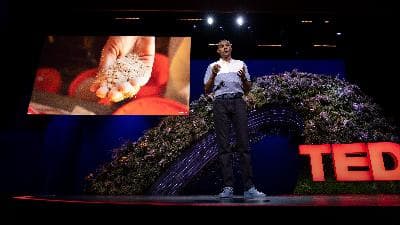
What seaweed and cow burps have to do with climate change | Ermias Kebreab
Scientists have long known that cows are a huge source of the greenhouse gas methane, contributing up to four percent of emissions globally. But could there be a way to make cattle less -- ahem -- gassy? Animal scientist Ermias Kebreab talks through an ingenious solution to reduce methane-rich cow burps by feeding cattle something growing below the surface of the ocean: seaweed.
۰:۰۰ / ۹:۰۱صوتی
صف پخش
- در حال پخش: What seaweed and cow burps have to do with climate change | Ermias Kebreab
- بعدی: Are life-saving medicines hiding in the world's coldest places? | Normand Voyer
- بعدی: What to do when there's a polar bear in your backyard | Alysa McCall
- بعدی: The fantastically weird world of photosynthetic sea slugs | Michael Middlebrooks
- بعدی: Where does your sense of self come from? A scientific look | Anil Ananthaswamy
- بعدی: Can we feed ourselves without devouring the planet? | George Monbiot
گزارش مشکل فایل
اگر پخش یا دانلود این قسمت خراب است، به مدیر اطلاع دهید.
قسمتهای بعدی
Could we treat Alzheimer's with light and sound? | Li-Huei Tsai
What if we could use brain waves to treat Alzheimer's? Professor and neuroscientist Li-Huei Tsai details a promising new approach to artificially stimulate gamma brain waves using light and sound therapy, to increase…
How biochar removes CO2 from the air -- and helps farmers thrive | Axel Reinaud
Biochar is a kind of charcoal that removes CO2 from the atmosphere, helping yield healthy crops and even producing abundant renewable energy in the form of electricity as it's made. This exciting climate change fighter…
A king cobra bite -- and a scientific discovery | Gowri Shankar
A king cobra has enough venom to kill 10 people in a single bite. Recounting his near-death experience after being bitten by one of these majestic yet deadly snakes, conservationist and TED Fellow Gowri Shankar shares…
The science of extreme weather — and how to reduce the harm | Al Roker, Al Gore, David Biello and Latif Nasser
Floods, droughts, heat waves and cold blasts -- why is the weather becoming more extreme? Environmentalist and "America's weatherman" Al Roker discusses the link between climate change and disruptions to weather…
The problem of vaccine spoilage -- and a smart sensor to help | Nithya Ramanathan
Refrigerators do much more than store your groceries -- they're also vital to preserving and distributing vaccines. Illustrating the realities of (and threats to) global vaccine supply chains, technologist and TED…