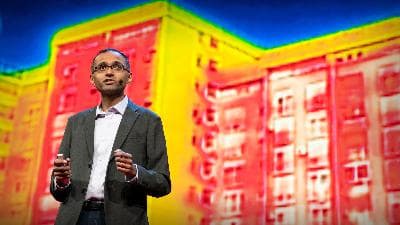
How we can turn the cold of outer space into a renewable resource | Aaswath Raman
What if we could use the cold darkness of outer space to cool buildings on earth? In this mind-blowing talk, physicist Aaswath Raman details the technology he's developing to harness "night-sky cooling" -- a natural phenomenon where infrared light escapes earth and heads to space, carrying heat along with it -- which could dramatically reduce the energy used by our cooling systems (and the pollution they cause). Learn more about how this approach could lead us towards a future where we intelligently tap into the energy of the universe.
۰:۰۰ / ۱۳:۱۷صوتی
صف پخش
- در حال پخش: How we can turn the cold of outer space into a renewable resource | Aaswath Raman
- بعدی: Are life-saving medicines hiding in the world's coldest places? | Normand Voyer
- بعدی: What to do when there's a polar bear in your backyard | Alysa McCall
- بعدی: The fantastically weird world of photosynthetic sea slugs | Michael Middlebrooks
- بعدی: Where does your sense of self come from? A scientific look | Anil Ananthaswamy
- بعدی: Can we feed ourselves without devouring the planet? | George Monbiot
گزارش مشکل فایل
اگر پخش یا دانلود این قسمت خراب است، به مدیر اطلاع دهید.
قسمتهای بعدی
The shocking danger of mountaintop removal -- and why it must end | Michael Hendryx
Research investigator Michael Hendryx studies mountaintop removal, an explosive type of surface coal mining used in Appalachia that comes with unexpected health hazards. In this data-packed talk, Hendryx presents his…
Scientists must be free to learn, to speak and to challenge | Kirsty Duncan
"You do not mess with something so fundamental, so precious, as science," says Kirsty Duncan, Canada's first Minister of Science. In a heartfelt, inspiring talk about pushing boundaries, she makes the case that…
The doctors, nurses and aid workers rebuilding Syria | Rola Hallam
Local humanitarians are beacons of light in the darkness of war, says humanitarian aid entrepreneur and TED Fellow Rola Hallam. She's working to help responders on the ground in devastated communities like Syria, where…
The "dead zone" of the Gulf of Mexico | Nancy Rabalais
Ocean expert Nancy Rabalais tracks the ominously named "dead zone" in the Gulf of Mexico -- where there isn't enough oxygen in the water to support life. The Gulf has the second largest dead zone in the world; on top of…
Should we create a solar shade to cool the earth? | Danny Hillis
In this perspective-shifting talk, Danny Hillis prompts us to approach global issues like climate change with creative scientific solutions. Taking a stand for solar geoengineering, he looks at controversial solutions…