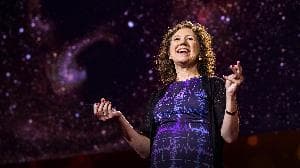
How LIGO discovered gravitational waves -- and what might be next | Gabriela González
More than 100 years after Albert Einstein predicted gravitational waves -- ripples in space-time caused by violent cosmic collisions -- LIGO scientists confirmed their existence using large, extremely precise detectors in Louisiana and Washington. Astrophysicist Gabriela González of the LIGO Scientific Collaboration tells us how this incredible, Nobel-winning discovery happened -- and what it might mean for our understanding of the universe. (In Spanish with English subtitles)
۰:۰۰ / ۱۳:۳۹صوتی
صف پخش
- در حال پخش: How LIGO discovered gravitational waves -- and what might be next | Gabriela González
- بعدی: Are life-saving medicines hiding in the world's coldest places? | Normand Voyer
- بعدی: What to do when there's a polar bear in your backyard | Alysa McCall
- بعدی: The fantastically weird world of photosynthetic sea slugs | Michael Middlebrooks
- بعدی: Where does your sense of self come from? A scientific look | Anil Ananthaswamy
- بعدی: Can we feed ourselves without devouring the planet? | George Monbiot
گزارش مشکل فایل
اگر پخش یا دانلود این قسمت خراب است، به مدیر اطلاع دهید.
قسمتهای بعدی
The most Martian place on Earth | Armando Azua-Bustos
How can you study Mars without a spaceship? Head to the most Martian place on Earth -- the Atacama Desert in Chile. Astrobiologist Armando Azua-Bustos grew up in this vast, arid landscape and now studies the rare life…
What it feels like to see Earth from space | Benjamin Grant
What the astronauts felt when they saw Earth from space changed them forever. Author and artist Benjamin Grant aims to provoke this same feeling of overwhelming scale and beauty in each of us through a series of…
What the sugar coating on your cells is trying to tell you | Carolyn Bertozzi
Your cells are coated with sugars that store information and speak a secret language. What are they trying to tell us? Your blood type, for one -- and, potentially, that you have cancer. Chemical biologist Carolyn…
Meet the microscopic life in your home -- and on your face | Anne Madden
Behold the microscopic jungle in and around you: tiny organisms living on your cheeks, under your sofa and in the soil in your backyard. We have an adversarial relationship with these microbes -- we sanitize,…
Why I still have hope for coral reefs | Kristen Marhaver
Corals in the Pacific Ocean have been dying at an alarming rate, particularly from bleaching brought on by increased water temperatures. But it's not too late to act, says TED Fellow Kristen Marhaver. She points to the…