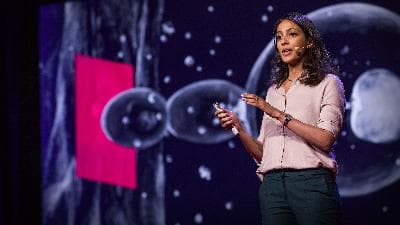
How fungi recognize (and infect) plants | Mennat El Ghalid
Each year, the world loses enough food to feed half a billion people to fungi, the most destructive pathogens of plants. Mycologist and TED Fellow Mennat El Ghalid explains how a breakthrough in our understanding of the molecular signals fungi use to attack plants could disrupt this interaction -- and save our crops.
۰:۰۰ / ۴:۲۳صوتی
صف پخش
- در حال پخش: How fungi recognize (and infect) plants | Mennat El Ghalid
- بعدی: Are life-saving medicines hiding in the world's coldest places? | Normand Voyer
- بعدی: What to do when there's a polar bear in your backyard | Alysa McCall
- بعدی: The fantastically weird world of photosynthetic sea slugs | Michael Middlebrooks
- بعدی: Where does your sense of self come from? A scientific look | Anil Ananthaswamy
- بعدی: Can we feed ourselves without devouring the planet? | George Monbiot
گزارش مشکل فایل
اگر پخش یا دانلود این قسمت خراب است، به مدیر اطلاع دهید.
قسمتهای بعدی
How we look kilometers below the Antarctic ice sheet | Dustin Schroeder
Antarctica is a vast and dynamic place, but radar technologies -- from World War II-era film to state-of-the-art miniaturized sensors -- are enabling scientists to observe and understand changes beneath the continent's…
The brain-changing benefits of exercise | Wendy Suzuki
What's the most transformative thing that you can do for your brain today? Exercise! says neuroscientist Wendy Suzuki. Get inspired to go to the gym as Suzuki discusses the science of how working out boosts your mood…
The role of human emotions in science and research | Ilona Stengel
Do human emotions have a role to play in science and research? Material researcher Ilona Stengel suggests that instead of opposing each other, emotions and logic complement and reinforce each other. She shares a case…
This deep-sea mystery is changing our understanding of life | Karen Lloyd
How deep into the Earth can we go and still find life? Marine microbiologist Karen Lloyd introduces us to deep-subsurface microbes: tiny organisms that live buried meters deep in ocean mud and have been on Earth since…
Could fish social networks help us save coral reefs? | Mike Gil
Mike Gil spies on fish: using novel multi-camera systems and computer vision technology, the TED Fellow and his colleagues explore how coral reef fish behave, socialize and affect their ecosystems. Learn more about how…