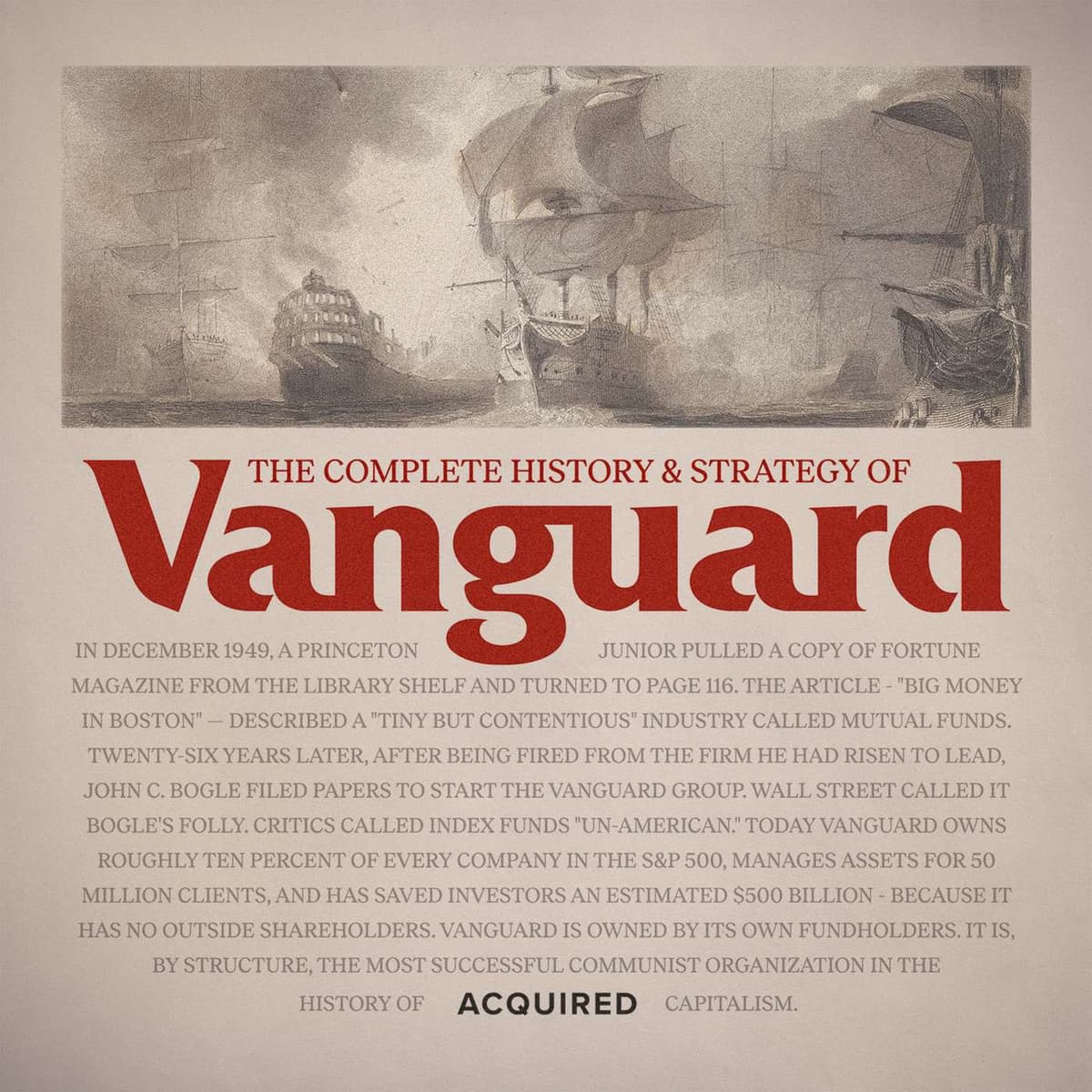
Vanguard
Vanguard is the most effective vehicle ever created for participating in the fruits of American capitalism. Today it’s the single largest equity owner of the majority of corporations in the S&P 500, on behalf of 50 million clients (including, likely, many of you). And yet Vanguard itself is essentially a communist organization — it has no shareholders, makes no profits, and operates more like REI than Fidelity. If you own a Vanguard fund, you own a piece of the firm itself. Any excess margin instead gets returned to clients in the form of lower fees, which since 1975 have added up to roughly five hundred billion dollars transferred out of Wall Street managers’ pockets and into retail investors’ savings accounts. And oh yeah, it all started as a cockamamie revenge plot by a guy who’d just been fired by his partners. Today we tell the story of communist capitalism at its finest — Vanguard. Sponsors: Many thanks to our fantastic Spring '26 Season partners: J.P. Morgan WeAreDevelopers event ServiceNow Vercel Statsig Links: This episode's PDF companion Sign up for email updates , get our takeaways and research photos from each episode, and vote on future topics! Our Vanguard "episode preview" in WSJ Stay the Course: The Story of Vanguard and the Index Revolution by John C. Bogle The Bogle Effect by Eric Balchunas Worldly Partners' Multi-Decade Vanguard Study Worldly Partners' Article Generational Investing: The Discipline Behind 100+x Outcomes All episode sources Carve Outs: Our WSJ pieces on Ferrari and Vanguard MacBook Pro M5 Max Michael MacKelvie on YouTube The Super Mario Galaxy Movie Brooks Vanguard sneakers More Acquired: Get email updates and vote on future episodes! Join the Slack Check out the latest swag in the ACQ Merch Store ! 00:00:00 Start 00:00:41 Intro 00:05:30 Jack Bogle's Early Life & Family Ruin (1929) 00:12:34 Princeton Thesis & Mutual Funds Emerge (1949-1951) 00:27:20 Joining Wellington Management (1951) 00:30:38 The Go-Go Years & Fidelity's Ascent (1958-1965) 00:40:36 Jack Takes the Reins & The Ivest Merger (1965) 00:46:04 The Go-Go Bust & Jack's Crisis of Conscience (1970-1973) 00:53:28 Jack is Fired: The Genesis of Vanguard (1974) 01:13:03 The Journal Article That Inspired It All (1974-1976) 01:35:02 Building the Fund & Early Struggles (1976-1981) 01:44:32 The Rise of Indexing & Vanguard's Growth (1988-1992) 01:49:06 Jack's Health & The CEO Transition (1995-1996) 02:00:06 The ETF Debate & Jack's Second Firing (1999) 02:24:18 The 2008 Financial Crisis: Vanguard's Moment 02:30:46 The Warren Buffett Bet (2008-2019) 02:41:28 Fidelity & BlackRock's Resurgence (Post-2008) 02:52:04 Salim Ramji: Vanguard's First Outside CEO 03:04:43 Wellington's Comeback & Mutual Ownership 03:08:23 Analysis 03:30:58 Quintessence 03:39:35 Carve-Outs + Outro Note: Acquired hosts and guests may hold assets discussed in this episode. This podcast is not investment advice, and is intended for informational and entertainment purposes only. You should do your own research and make your own independent decisions when considering any financial transactions.
۰:۰۰ / ۳:۴۸:۰۵صوتی
صف پخش
- در حال پخش: Vanguard
- بعدی: Disney: The Renaissance and the Empire
- بعدی: The Walt Disney Company
- بعدی: Ferrari
- بعدی: Rolex
- بعدی: Costco
گزارش مشکل فایل
اگر پخش یا دانلود این قسمت خراب است، به مدیر اطلاع دهید.
قسمتهای بعدی
Rolex
Rolex is a series of paradoxes. They sell obsolete and objectively inferior mechanical devices for 10-1000x the price of their superior digital successors… and demand is stronger than ever in history! Their products are…
Costco
Costco is not only Charlie Munger’s favorite company of all time (plus he’s on the board, natch), it’s an absolutely fascinating study in how seemingly opposite characteristics can combine to create incredible company…
Formula 1
Formula 1 is three competitions in one: a 200mph battle of the world's best race car drivers, the world cup of engineering where thousand-person teams spend hundreds of millions designing cars from scratch, and — as one…
The NFL
The NFL is nearly synonymous with America today. Practically nothing is more quintessentially and universally American than tuning in every Sunday (and Monday, and Thursday… and sometimes Saturdays and holidays too) to…
10 Years of Acquired (with Michael Lewis)
Why has Acquired — seemingly against all odds — “worked”? It's a puzzling question: episodes are four hours long, they come out infrequently, and they usually don’t have guests or video. Hardly the standard-issue…